We are pleased to offer you 5 tactics and strategies used by the best pro players in their training sessions and matches — completely free.
For each drill, you’ll find videos and animations, along with technical explanations and coaching tips.
Subscribe now to unlock the full site:
- 350+ padel drills and training sessions, all inspired by the pros, with new exercises added every week.
- Create your own custom training sessions with the exercises of your choice.
- Mark drills as completed to track your progress over time.
- Save your favorite drills in the “My Favorites” section.
Lob Tactics: hit a good diagonal lob and follow it with a cross-court shot toward the diagonal fence
This tactic, highly effective at both beginner and advanced levels, consists of taking advantage of the space created by a high diagonal lob by playing your next shot into the open area along the diagonal fence.
Knowing this combination also helps you anticipate and plan your next shot after your diagonal lob, allowing you to play more intelligently with a clear game plan.
Video credits: USE These THREE LOB COMBINATIONS to Take the Net! | ThePadelSchool.com – YouTube
The tactic
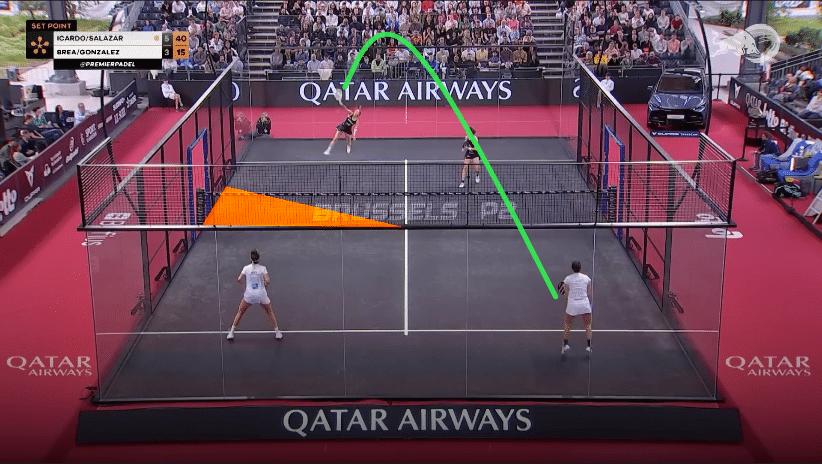
The tactic consists of hitting a good high diagonal lob and then following it with a low cross-court shot aimed toward the diagonal mesh.
Your first diagonal lob will automatically create a triangular open space that you can target with your next shot—either with a ball that rebounds off the diagonal mesh, or with a chiquita that drops at your opponent’s feet.
In both cases, your opponent will be in trouble and out of position.
Theoretical explanations
Beginner level:
At beginner level, this tactic is useful because it makes you think about your next shot after the lob.
After returning your lob, your opponent often won’t move back up to the net quickly, leaving a large open area—a wide triangular space—into which you can play your follow-up shot.
You don’t need a spectacular shot: no extreme spin, perfect angle, high power, or a perfectly precise chiquita that dies just before the mesh. Simply play calmly into the open space.
The more your opponent returns your lob with a cross-court angle, the easier it will be for you to target the diagonal mesh with your next ball.
The lob must be diagonal for this tactic to work and for this space to open. It does not work with a parallel lob.
Advanced level:
At a higher level, you can refine your low shot—either with a well-placed, slower chiquita that drops at your opponent’s feet, or with a strong ball that rebounds off the fence.
In both cases, it will be a difficult ball for your opponent to return, and they will inevitably end up out of position afterward.
Automating this play sequence to capitalize on the serve with a strong volley combination
Working on specific patterns after the serve helps create automatic reactions that can be reproduced more accurately in matches, even under pressure.
This sequence begins with a simulated serve, followed by three balls fed by the coach to reproduce a classic volley sequence.
The balls are fed from a basket to eliminate uncertainty and encourage repetition—an essential condition for effectively anchoring the pattern of play.
Setup
To begin the sequence, the player positions themselves to serve (either on the left or right side, as the drill can be performed symmetrically on both sides).
Drill execution
The player simulates the service motion (without a ball) and quickly moves forward to the net.
The coach feeds the first volley while the player is running to the net. On this first ball, the player cannot take risks since they are still moving forward. They therefore play a safe transition volley.
Once fully positioned at the net, the player hits a second volley, this time with more aggression. The goal of this second volley is to put pressure on the opposing pair, with a shot played in a good area and with little bounce.
The coach then sends a high, deep lob. The player moves back and must decide whether to hit a bajada de pared if the lob comes well off the back glass, or to reset the point by playing a high, deep lob to recover net position.
Repetitions
The player then restarts the sequence from the beginning. It can be repeated 5 to 10 times to maximize automatisms and sharpen reactions.
A short break of a few seconds between series can be taken to recover and reflect on adjustments.
It is important to apply strong intensity on each ball to simulate real match conditions.
Here’s a video demonstration of the exercise:
Paquito Navarro: a simple tactic to take the initiative from the serve – a serve on the T and an aggressive volley in the open space
This exercise demonstrates a simple tactic used by many players on the pro circuit, including Paquito Navarro, to gain the advantage in the exchange from the very start of the point.
It consists of training the following strategy right from the serve: a serve on the T, followed by an aggressive volley into the space freed up by the receiver’s movement.
Description:
Two pairs position themselves in their usual roles.
The players play one or several tie-breaks while trying to apply the following strategy:
The server hits their first serve straight down the T, with depth.
They then move forward to the net, and the attackers play an aggressive volley into the space opened by the receiver’s movement toward the T. The first volley will therefore be played into the receiver’s glass corner.
The servers use this strategy only on the first serve, because it needs to be firm and aggressive for the tactic to work properly. The defender will then have very little time to recover their corner after the return.
Try to apply a good slice effect on the serve so the ball digs into the ground right after bouncing off the back glass. It will then be very difficult to return if the defender plays it after the glass rebound.
From time to time during the tie-break, the defenders vary their serves, aiming at the side glass for example, to surprise the opponents and avoid being too predictable.
The receivers must try to counter this strategy however they can, with an immediate lob, a chiquita return, or a shot toward the opponents’ weak spot.
The points then continue as free play.
Technical–tactical advice:
It is essential that this first attacking volley bounces on the back glass (glass 3) and then on the side glass (glass 2), in that order and not the opposite, to send the ball away from the defender’s recovery path.
If you aim for the side glass first and it then rebounds onto the back glass, it will actually be counterproductive because the ball will come back toward the defender’s movement.
So attack directly toward glass 3, the back glass near the corner.
Lob Tactics: Play a chiquita right before your lob to pull your opponent toward the net and create space behind them
This tactical combination consists of playing a chiquita right before your lob, in order to prepare your approach to the net and increase the effectiveness of your lob.
The lob is an extremely tactical shot in padel, as it allows you to recover an offensive position starting from defense. Understanding the tactical fundamentals of when and why you should lob is therefore crucial.
This drill aims to introduce a tactical pattern you can use—regardless of your level—to make your lob more effective and to succeed more often when transitioning to the net.
Video credits: USE These THREE LOB COMBINATIONS to Take the Net! | ThePadelSchool.com – YouTube
The tactic
This tactic consists of playing a chiquita just before your lob, bringing your opponent closer to the net and naturally creating space behind them.
Every time you decide to lob, you should think: I play a chiquita first, and then I follow with my lob.
Theoretical explanation
At a beginner level, playing a chiquita followed by a lob changes the rhythm for your opponent, who has just received a low ball at their feet and may expect another ball down low.
At an intermediate or advanced level, your chiquita forces your opponent to move closer to the net, creating more space behind them.
The shorter and softer your chiquita is, the more they will be forced to step forward to reach it—and every step they take toward the net is one more meter of space you can use to hit your lob.
At a professional level, you will often see the sequence chiquita → volley lob, to immediately capitalize on the opponent stepping forward to retrieve the chiquita.
The combination chiquita at the feet → lob is therefore extremely useful and should be applied in your matches, no matter your level.
Practice this tactic during training to make it automatic, and also practice it with your partner so they can anticipate your next shot and follow you to the net more easily.
Sanyo Gutiérrez: attacking through the center, with varying power to disrupt the opposing pair
In padel, varying your shot placement and power is one of the most effective tools for winning points, as it disrupts the patterns and anticipations your opponents rely on.
This strategy, used in matches by the pair Seba Nerone and Sanyo Gutiérrez, offers great variation through a moderately paced attack aimed at the center of the court.
The objective of this drill is to show that playing more often through the middle can be effective. This “divorce zone” frequently creates doubt and hesitation between opponents, whether they are at the net or in defense.
Description
Two pairs position themselves in a free-play situation.
The players will play one or several tie-breaks with the objective of applying the following tactic:
The team at the net tries to play their aggressive shots more often toward the middle of the court, looking to create misunderstandings between their opponents and hesitation about who should take the ball.
The players vary well between playing into the corners and playing through the middle, while trying to move their opponents as much as possible.
The attackers focus on varying their power; there is no need to play only powerful shots.
The defensive shots can be played freely anywhere on the court.
Once again, this drill shows that playing through the middle, when used wisely, is a valuable tool that every player should know how to use, and that it will surely help raise your level of play.
Here is a video demonstration of how professional players Seba Nerone and Sanyo Gutiérrez used this tactic:
Video credits: ESCUELA DE PÁDEL – Rafa Gálvez – PADEL – ATAQUE POR EL CENTRO : SANYO GUTIERREZ – YouTube
👉 Explore all our tactical drills: Tactical drills
➡️ Discover all our ready-to-use sessions: Session templates
Explore all the 300+ exercices and training sessions available on TrainingPadel.com here: